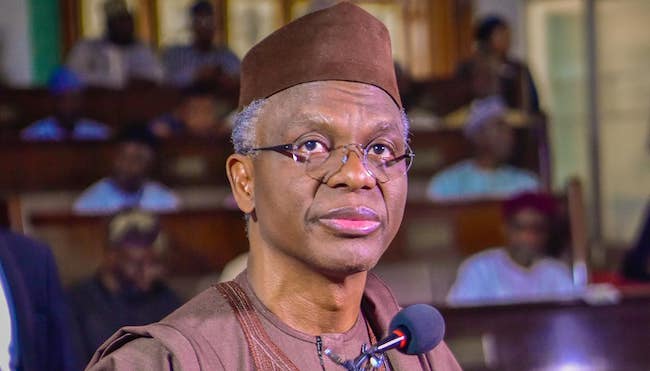


The Economic and Financial Crimes Commission on Monday night detained former Kaduna State Governor, Nasir El-Rufai, following hours of questioning over an alleged N432bn corruption probe.
El-Rufai, who arrived at the commission’s Jabi headquarters in Abuja around 10am in response to an invitation, was interrogated over allegations linked to the 2024 report of the Kaduna State House of Assembly, which accused his administration of mismanaging loans, breaching due process in contract awards and plunging the state into heavy debt.
Senior officials within the anti-graft agency told our correspondents that the investigation had been ongoing for about a year before the former governor was invited for questioning.
“As a commission, we do not act in haste. Suspects are usually invited after investigations have reached an advanced stage.”
“We are probing the allegations raised by the Kaduna State Assembly,” a source disclosed.
When asked late Monday whether the former governor would be released, the source said he remained in custody and would not regain his freedom that night.
The EFCC spokesman, Dele Oyewale, confirmed that El-Rufai honoured the commission’s invitation but declined to comment on the details of the interrogation or the next course of action.
The probe stems from the report of an ad hoc committee set up by the Kaduna State House of Assembly in 2024 to review loans, finances and contracts awarded between 2015 and 2023 during El-Rufai’s tenure.
Presenting the panel’s findings during plenary, the committee chairman, Henry Zacharia, alleged that a significant portion of the loans secured under the former governor was not utilised for their intended purposes.
The Speaker of the House, Yusuf Dahiru Leman, while receiving the report, alleged that about N423bn was siphoned, leaving the state with mounting liabilities and a rising debt burden.
The committee recommended the investigation and prosecution of El-Rufai and key members of his cabinet over alleged abuse of office, diversion of public funds, money laundering and reckless borrowing.
The Assembly subsequently petitioned both the EFCC and the Independent Corrupt Practices and Other Related Offences Commission.
Beyond the headline figure, the report also cited disputed payments and contracts worth over N155m, the alleged diversion of N1.37bn earmarked for a light rail project and the purported laundering of N64.8m by senior aides.
El-Rufai has consistently rejected the allegations, describing them as politically motivated and insisting that all loans obtained during his administration were properly appropriated and deployed for infrastructure, education, healthcare and security interventions.
Meanwhile, the Federal Government has filed criminal charges against the former governor before the Federal High Court in Abuja over the alleged unlawful interception of the phone communications of the National Security Adviser, Nuhu Ribadu.
The three-count charge, marked FHC/ABJ/CR/99/2026, was filed under the Cybercrimes (Prohibition, Prevention, etc.) Amendment Act, 2024 and the Nigerian Communications Act, 2003.
According to the charge sheet, the Federal Government alleged that during a television interview on February 13, 2026, El-Rufai admitted that he and unnamed associates unlawfully intercepted Ribadu’s communications.
In the first count, the prosecution alleged that the former governor admitted during the interview that he and others intercepted the NSA’s phone communications, an offence punishable under Section 12(1) of the Cybercrimes (Prohibition, Prevention, etc.) Amendment Act, 2024.
The second count accused him of acknowledging association with an individual who unlawfully intercepted the NSA’s communications without reporting the act to relevant authorities, contrary to Section 27(b) of the Act.
The third count alleged that El-Rufai and others still at large used technical equipment to compromise public safety and national security by intercepting the NSA’s phone communications, an offence punishable under Section 131(2) of the Nigerian Communications Act, 2003.
The prosecution claimed the alleged admission generated apprehension among Nigerians over issues of national security.
As of press time, no date had been fixed for his arraignment.