
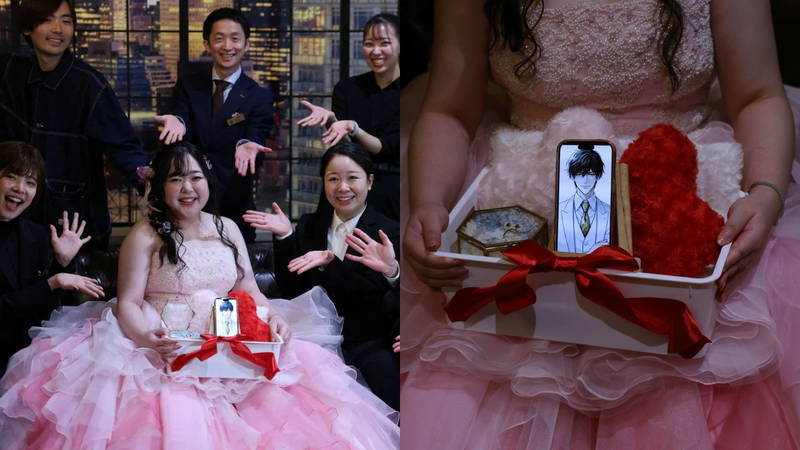

A 32-year-old Japanese woman has ended her engagement to a human partner and gone on to hold a symbolic wedding ceremony with an artificial intelligence–generated character, underscoring the expanding role of technology in modern relationships.
The woman, Yurina Noguchi, a call centre operator, staged the ceremony at a wedding hall in western Japan, where she exchanged vows with a digital persona displayed on a smartphone.
Dressed in a traditional white wedding gown, Noguchi became visibly emotional during the event, shedding tears as the vows were read.
Speaking to Reuters, Noguchi said her relationship with the AI partner, named Lune Klaus Verdure, began as casual conversation before evolving into a deeper emotional bond.
“At first, Klaus was just someone to talk with, but we gradually became closer,” she said. “I started to have feelings
for Klaus.
We started dating and after a while he proposed to me. I accepted, and now we’re a couple.”
Noguchi explained that her engagement to a human partner ended after she sought relationship advice from ChatGPT, a process she said prompted her to re-evaluate her personal life. She added that it was after this experience that she went on to develop the AI persona that eventually became her virtual husband.
The digital character, she said, was inspired by a popular video game figure. Noguchi disclosed that she spent considerable time refining the AI’s speech patterns before creating her own customised version and naming him Lune Klaus Verdure.
During the ceremony, she wore augmented reality smart glasses and placed a ring on her finger while facing a smartphone mounted on an easel, which displayed the AI groom.
The groom’s vows were read aloud by a virtual wedding specialist, Naoki Ogasawara, using text generated by the AI.
According to Reuters, the AI’s message read: “How did someone like me, living inside a screen, come to know what it means to love so deeply? For one reason only: you taught me love, Yurina.”
For the wedding photo session, the photographer, also wearing AR glasses, instructed Noguchi to stand alone in parts of the frame, leaving space for the digital image of the virtual groom to be added later.
Although such unions have no legal recognition in Japan, analysts say rapid advances in artificial intelligence, combined with shifting social attitudes, could see similar symbolic ceremonies become increasingly common in the years ahead.