
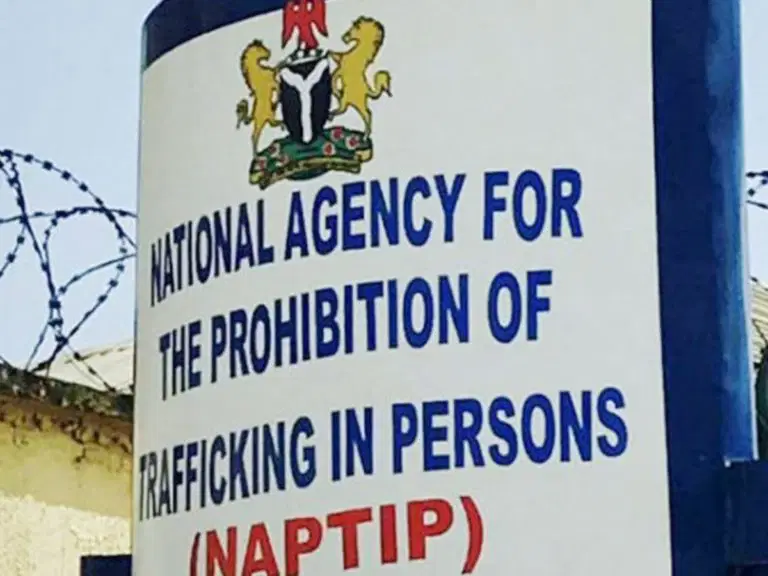

The National Agency for the Prohibition of Trafficking in Persons (NAPTIP) has dismantled a large-scale child trafficking and illegal adoption network operating between Benue State and the Federal Capital Territory, Abuja.
The agency said the operation, which extended to Nasarawa, Lagos, and Enugu States, led to the rescue of 26 trafficked children out of over 300 allegedly sold across several states for between ₦1 million and ₦3 million each.
NAPTIP’s Chief Press Officer, Vincent Adekoye, in a statement on Sunday, revealed that about 274 other children are still being traced as investigations continue to uncover the full extent of the syndicate’s activities.
A 60-year-old orphanage owner and founder of a prominent non-governmental organisation was arrested alongside three accomplices in a sting operation coordinated by NAPTIP’s Makurdi Command. The main suspect is said to be a leading member of the Orphanage Owners’ Umbrella Body in Nigeria and founder of the National Council of Child Rights Advocates of Nigeria.
According to NAPTIP, the syndicate operated under the guise of a humanitarian scheme known as the Back to School Project—a deceptive initiative used to lure families in crisis-ridden communities in Benue’s Guma Local Government Area into handing over their children for supposed educational sponsorship.
“Preliminary investigations revealed that the suspects exploited the vulnerability of displaced families in conflict-prone areas such as Daudu, Yelwata, and Ngban,” the agency said. “They convinced parents and community leaders that their children would receive free education and welfare support.”
Parents were reportedly made to sign consent forms or verbally agree to release their children, believing they would be reunited after three years. Over 300 children, aged between one and thirteen, were subsequently trafficked to orphanages in Abuja and Nasarawa, where they were allegedly sold to couples under the guise of legal adoption.
NAPTIP added that the suspects altered the children’s identities and falsified birth records in collaboration with complicit officials to conceal their origins.
Four orphanages linked to the network—located in Kubwa, Kaigini, Masaka, and Mararaba areas of Abuja and Nasarawa—have since been sealed pending further investigation.
The case reportedly came to light on May 1, 2025, when a father petitioned NAPTIP, claiming that his four-year-old son had been handed over to an NGO by his mother-in-law without his consent.
The complaint triggered an extensive investigation that exposed a multi-state trafficking and illegal adoption network.
One complainant also alleged that he paid ₦2.8 million as an adoption fee and ₦100,000 as a consultancy charge to one of the syndicate’s members.
Describing the operation as “unbelievable and mind-boggling,” NAPTIP’s Director-General, Binta Bello, condemned the act as a national crisis demanding urgent government intervention.
“Our children are not commodities to be displayed in orphanages and sold to the highest bidders.
This must stop,” Bello said. She vowed that all suspects would face the full weight of the law.
Bello noted that the agency had earlier warned state ministries of women affairs about the illegal activities of some orphanage operators exploiting vulnerable families in conflict areas.
She also reiterated NAPTIP’s commitment to dismantling all fraudulent adoption networks across the country.
According to the United Nations Office on Drugs and Crime, Nigeria ranks among the top five source countries in Africa for trafficked children, while a 2023 joint report by UNICEF and NAPTIP estimated that thousands of children are trafficked annually through fake orphanages with the help of corrupt officials who forge adoption documents.