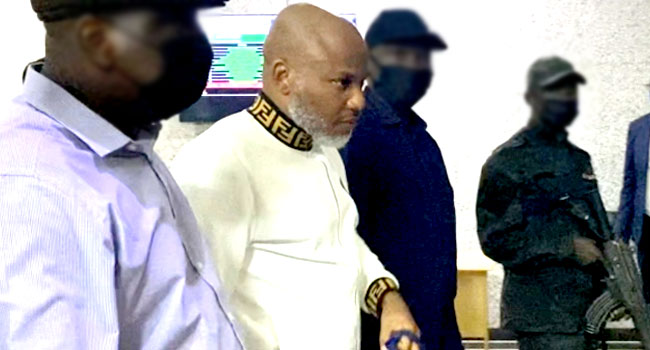


Detained leader of the Indigenous People of Biafra (IPOB), Nnamdi Kanu, has agreed to consult his lawyers before proceeding with his defence in the terrorism case instituted against him by the Federal Government.
Justice James Omotosho of the Federal High Court, Abuja, made the suggestion during Wednesday’s hearing, after Kanu again questioned the validity of the seven-count charge filed against him.
The judge advised the IPOB leader to seek proper legal guidance before taking any further steps in his trial.
Initially reluctant to continue, Kanu later informed the court that he would confer with his legal team, which includes Nnaemeka Ejiofor, Aloy Ejimakor, Maxwell Okpara and Mandela Umegborogu.
Following his request, Justice Omotosho adjourned the case till November 7, the fourth time the defendant has been given an opportunity to open his defence or waive his right to do so.
Kanu had in October disengaged his former legal team led by a former Attorney-General of the Federation, Chief Kanu Agabi (SAN), opting to conduct his defence personally.
He had earlier listed 23 witnesses, including Lagos State Governor Babajide Sanwo-Olu and Minister of the Federal Capital Territory Nyesom Wike, but later changed his stance, insisting there was no valid charge against him.
At Wednesday’s proceedings, Kanu maintained that the law under which he is being prosecuted — the Terrorism Prevention and Prohibition Act — had been repealed, arguing that he could not be tried under a non-existent law.
“The Terrorism Prevention and Prohibition Act has been repealed. I cannot put up a defence under a repealed law,” he told the court, adding that the prosecution failed to amend the charges as directed by the Supreme Court.
The Federal Government’s counsel, Adegboyega Awomolo (SAN), urged the court to enforce its previous order compelling Kanu to either open his defence or forfeit the right to do so.
But Justice Omotosho said he would “once again bend backward” in the interest of justice, granting the defendant more time to consult lawyers versed in criminal law before the next sitting.
The prosecution had closed its case on June 19 after calling five witnesses, with the court ruling on September 26 that a prima facie case had been established against Kanu.