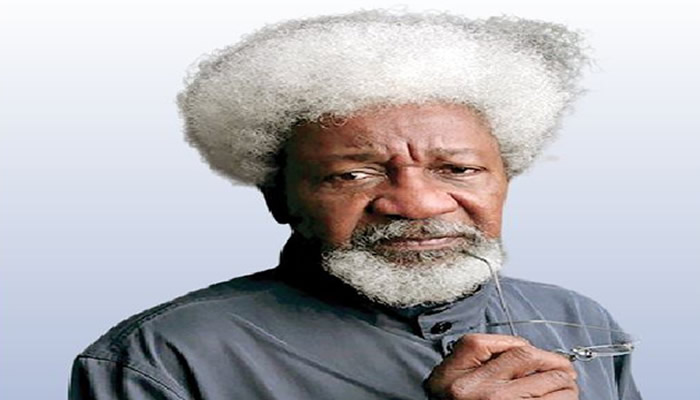


Nobel laureate Prof. Wole Soyinka has criticised President Bola Ahmed Tinubu for Nigeria’s military role in the recently thwarted coup attempt in the Republic of Benin, warning that such actions pose serious risks to regional stability and the country’s internal security.
Soyinka spoke on Monday in Lagos at the 20th Wole Soyinka Centre for Investigative Journalism (WSCIJ) Awards, where he delivered a brief but forceful reflection on governance failures, human rights violations, surging insecurity and the spread of misinformation.
The literary icon condemned what he called “another needless military entanglement next door,” insisting that the Benin incident should prompt Nigeria to reinforce its democratic systems rather than resort to military responses.
He cautioned that any political upheaval in a neighbouring country would inevitably have consequences for Nigeria.
According to him, “What happens in Benin inevitably affects us. Instability anywhere in the region echoes within our own sense of security.”
Soyinka also took a swipe at recent demolition exercises across Lagos, describing the treatment of displaced residents as harsh and unacceptable.
He revealed that he had received pictures and personal accounts from victims left without shelter, noting that forced evictions had become worryingly frequent.
While acknowledging the necessity of removing unsafe structures, he insisted that such operations must be carried out with compassion and proper safeguards for vulnerable communities.
“We must not strip away the humanity of the people affected,” he said, emphasising that development must never be pursued without compassion.
The Nobel laureate further criticised what he described as an unusually large security detail attached to a young individual close to the Presidency, saying the formation was large enough “to take over a small country.” He questioned why a non-government official would command such an intimidating entourage, calling it a misuse of state resources.
“Children must understand their place. They are not elected leaders and must not inherit the instruments of state power simply by proximity,” he said.
Turning to the role of the press, Soyinka commended journalists for their courage but urged stronger editorial gatekeeping in an era plagued by misinformation.
He warned that unchecked online falsehoods could one day trigger global instability.
He added that the country’s strongest defence against chaos lies in responsible journalism anchored on truth, verification and professional ethics.