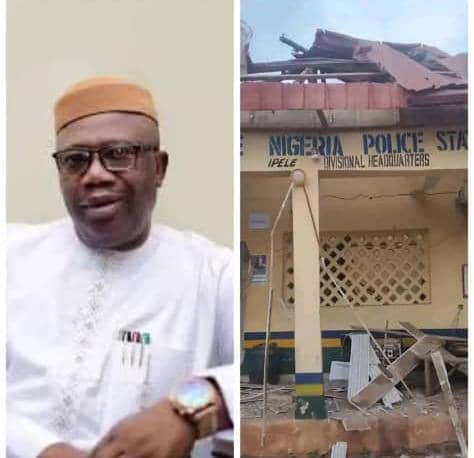


Moments of crisis often expose the strength of leadership as much as they reveal the vulnerability of public institutions. The recent attack on the Ìpele Police Station was more than an assault on a building; it struck at the heart of public order and community safety, leaving residents shaken and anxious.
At such times, hesitation from those in authority can deepen uncertainty. Swift and purposeful action, however, has the power to calm fears and restore confidence. It was within this context that Senator Olajide Ipinsagba, representing Ondo North Senatorial District, stepped forward with a response anchored in action rather than words.
Shortly after news of the attack broke, the senator provided direct support for the reconstruction of the damaged police facility, donating 2,500 blocks and 200 bags of cement to ensure repairs could commence without delay. The intervention underscored an understanding that security infrastructure is too critical to be left in limbo and that affected communities deserve immediate reassurance.
Beyond the material assistance, the response carried a strong cultural and moral undertone. A palace source in Ìpele confirmed that Senator Ipinsagba personally contacted the town’s traditional ruler, Kabiyesi, to express his condolences and solidarity with the people.
“The senator called Kabiyesi to commiserate with him and assured us of his full support, promising to visit the palace personally. The building materials have already arrived, and we are grateful for his timely intervention,” the source said.
Within Yoruba political tradition, such engagement is deeply symbolic. It reflects the belief that effective governance thrives when modern political authority works in harmony with traditional institutions. By reaching out to the palace, the senator reinforced the principle that sustainable development and security are best achieved through mutual respect and cooperation.
For residents of Ìpele, the gesture aligns with a familiar pattern. Senator Ipinsagba has, over time, maintained a steady presence in the community, drawing federal attention to local concerns, supporting development efforts and responding to issues that directly affect daily life.
This latest intervention further affirms his stance that security should not remain a distant policy conversation but a lived reality supported by functional institutions and public trust. In assisting the rebuilding of the police station, he has helped restore not just a structure, but confidence in responsive representation.
As reconstruction begins, the materials provided will soon take form in bricks and walls. More enduring, however, is the message sent to the people of Ìpele: that their community matters, that their safety is a priority, and that in moments of trial, leadership can still choose to act promptly and stand visibly with the people.