
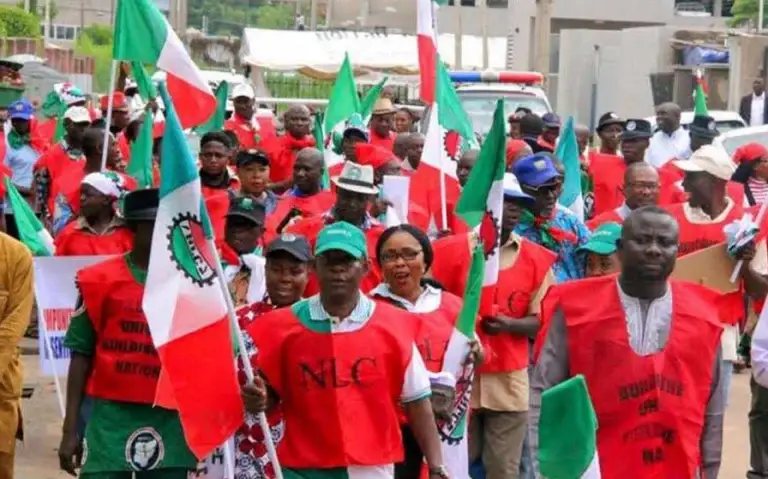

The Nigeria Labour Congress (NLC) has delivered a harsh verdict on President Bola Tinubu’s administration, declaring that two years into his tenure, Nigerians have seen no meaningful improvement—only worsening suffering and economic hardship.
NLC President, Joe Ajaero, made this assessment in a statement marking the administration’s second anniversary.
According to him, the promises of economic reform and national renewal have instead translated into deepening poverty and despair for workers and ordinary citizens.
“When President Tinubu took office on May 29, 2023, he pledged bold reforms to steer Nigeria away from fiscal instability and onto a path of prosperity,” Ajaero said. “Two years later, what we have is bold suffering. His policies have brought nothing but pain.”
He criticized the abrupt removal of fuel subsidies, which triggered a sharp spike in petrol prices—from ₦187 to over ₦600 per litre.
Though the government justified it as a step toward development, Ajaero questioned where the supposed gains had gone.
“Instead of development, Nigerians got record-breaking inflation. Families are skipping meals, transport costs are unaffordable, and businesses are shutting down.
The naira has collapsed under so-called ‘market forces,’ turning Nigeria into a dumping ground while local industries struggle to survive,” he said.
Ajaero described the administration’s economic direction as a repetition of failed neoliberal policies—fuel subsidy cuts, currency devaluation, and externally imposed austerity measures—which, according to him, have never worked for Nigeria.
“These are not new policies. We’ve seen them fail under previous governments. All they have ever done is widen inequality, enrich a few, and deepen the suffering of the masses,” he said. “Tinubu’s version is just more brutal and more damaging.”
The NLC lamented the erosion of workers’ real wages, rising poverty, and inflation rates that have reportedly pushed over 150 million Nigerians into multidimensional poverty.
Small businesses, pensioners, and civil servants are all feeling the weight of what the NLC describes as an economic crisis.
The group also decried the federal government’s failure to pay promised wage award arrears and accused it of systematically suppressing labour activities. Ajaero cited the harassment of labour leaders, the criminalisation of union protests, and disregard for court orders as indicators of a shrinking democratic space.
He acknowledged the government’s introduction of compressed natural gas (CNG) buses to alleviate transport costs but dismissed the measure as insufficient, citing the lack of supporting infrastructure.
“Dialogue with Labour has been replaced with intimidation.
Workers asking for a living wage are met with tear gas and threats, while public officials continue to live extravagantly,” Ajaero said. “The same people asking Nigerians to make sacrifices are feasting on bloated budgets and travelling in luxury convoys.”
He blamed a select few—oil cartels, currency speculators, and political elites—as the real beneficiaries of current economic policies, accusing them of working hand-in-hand with international financial institutions like the IMF and World Bank.
“None of this benefits the ordinary Nigerian,” Ajaero said. “It’s the usual suspects who win—the ones with offshore accounts and foreign backers. Meanwhile, the rest of the country suffers.”
He concluded by questioning the value of economic discourse in a country gripped by insecurity, warning that rising threats such as mass kidnappings and banditry have made national survival more pressing than fiscal policy.
“In a country plagued by violence, talking about economic policy feels like arguing over curtains while the house burns.
The hardship is real, and Nigerians are deeply worried about the future.”