
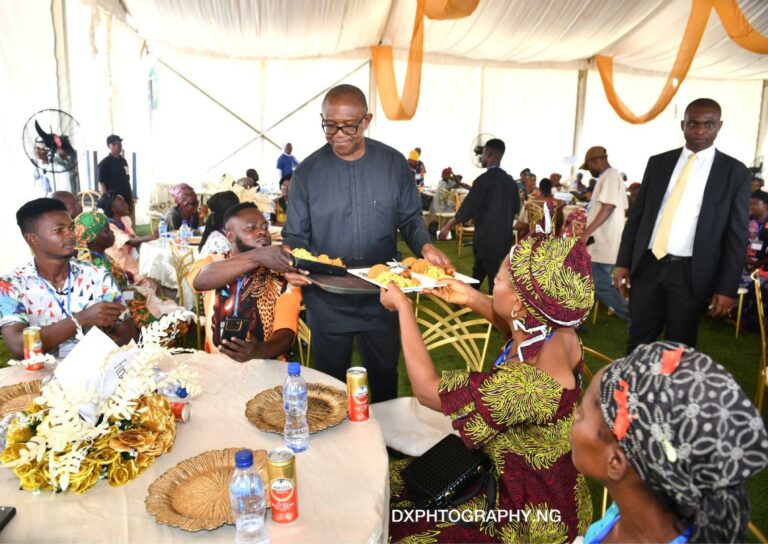

Former Labour Party presidential candidate, Peter Obi, has addressed public reactions to his recent appearance at a charity event in Imo State, where he was seen serving food to the underprivileged, stating that his actions were not politically motivated.
The event, titled Jubilee of Hope, held last week, drew widespread attention after photos and videos circulated online showing Obi personally serving meals to attendees.
While some praised the act as a display of humility, others dismissed it as a calculated political stunt.
In a statement posted on his X handle on Sunday, Obi clarified that the event was not about publicity but about promoting compassion and servant leadership.
“Let me be clear, that event was not about me,” Obi said. “Its purpose was to remind us that true leadership is rooted in service, and those who have must remember those who do not.”
Obi noted that the event was a private initiative and he had neither invited the media nor publicised his attendance.
He added that third parties who were present shared the images independently.
“As expected, the usual naysayers and paid agents went to work trying to twist something sincere into something political,” he said.
According to him, the Jubilee of Hope aimed to promote a culture grounded in empathy, equity, and responsibility, encouraging privileged individuals to identify with the less fortunate.
He mentioned that several notable Nigerians also participated in serving food, including Cardinal John Onaiyekan, Senator Osita Izunaso, and Dr. A.B.C. Orjiako, a former Seplat Chairman.
Reiterating his commitment to simple living, Obi said, “I live simply. I sweep, I clean. I do not have house help. When people visit me, I serve them myself. For me, humility is not a campaign strategy — it is a way of life.”
He explained that he spent more time at the event because many attendees specifically requested that he serve them, adding, “There was nothing special about what I did. Service is not special — it is expected.”
Obi urged Nigerian leaders and citizens alike to embrace a lifestyle of service and compassion, stressing that meaningful change cannot happen while the poor and vulnerable are ignored.
“We cannot talk about building a new Nigeria while neglecting the hungry and forgotten.
Events like this should not be symbolic alone — they must become a way of life,” he said.
He concluded by calling for a collective effort to create a country where hope and dignity are not privileges, but guaranteed rights.